
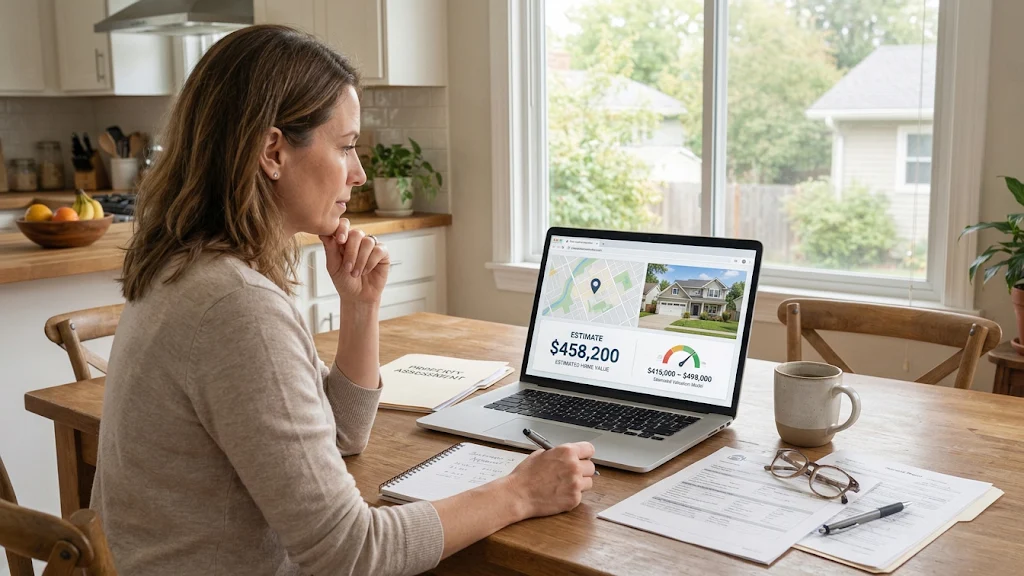
How Accurate Are Online Home Value Estimates? A Practical Guide for Homeowners
Checking an online estimate is often the fastest way to begin thinking about a move, refinancing, available equity, or a future listing. A review of home value estimator accuracy can also help homeowners understand why one number should be treated as a starting point rather than a final answer.
Convenience does not guarantee precision. Two homes on the same street may receive similar automated estimates even if one has a remodeled kitchen, a newer roof, better views, or costly maintenance needs that are not reflected in the data.
Why Homeowners Check Online Estimates
Instant estimates can make early planning easier. They offer a quick reference point when you are considering whether a sale could support your next purchase, whether refinancing may be worthwhile, or how much equity you may have. The number becomes more useful when it is paired with local market evidence and accurate property details.
How Automated Valuation Models Work
An automated valuation model, often called an AVM, is a computer-generated estimate that analyzes available property and market information. Common inputs include recent comparable sales, square footage, property type, bedroom and bathroom counts, tax records, historical transactions, and local pricing trends. The Consumer Financial Protection Bureau explains how automated valuation models work by noting that these systems compare home characteristics to recent sales and other local housing market information.
Each provider can weigh those inputs differently. One model may place greater weight on recent sales, while another may rely more heavily on recorded characteristics or broader neighborhood trends. A disagreement between estimates does not automatically mean that one tool is broken.
Why Estimates Differ From One Website to Another
Property databases are not identical. One website may have a newly recorded sale, a corrected square-footage figure, or listing information that another site has not yet incorporated. Models can also select different comparable homes, use different geographic boundaries, and update on different schedules.
Photorealistic macro close-up of a homeowner reviewing several home value estimates on a laptop beside printed property records, with the screen, paper textures, and handwritten comparison notes in sharp focus and a softly blurred home interior in the background.
Listed homes may yield different results than homes that are not actively marketed, because current listing data can provide useful signals about price, condition, and buyer interest. Estimates can change again when a sale closes, public records are updated, or a homeowner corrects inaccurate information.
Property Details Online Tools May Miss
Public records rarely tell the complete story. An automated estimate may not fully capture remodeled kitchens and bathrooms, the condition of the roof or HVAC, water damage, deferred maintenance, a finished basement, lot privacy, traffic noise, street position, or a view. It may also fail to determine whether an addition was permitted.
Before comparing estimates, make a short property fact sheet. Include the home’s recorded size, major improvements, dates of replacements, special features, known defects, and any spaces that differ from public records. This gives you a practical checklist for deciding whether a comparable home is truly comparable.
How to Check Whether an Estimate Looks Reasonable
- Confirm that the address, square footage, bedroom count, bathroom count, and lot details are correct.
- Review at least three recent nearby closed sales with a similar property type and size.
- Look at active listings that are competing for the same likely buyers.
- Adjust your comparison for condition, upgrades, layout, lot usability, and location.
- Develop a range of values instead of relying on a single exact figure.
Closed sales show what buyers actually paid, while active listings show the choices buyers have today. An asking price is useful market information, but it is not proof of market value because a seller can list at any price.
Online Estimate, CMA, and Appraisal: What Is the Difference?
These valuation tools can overlap, but they are not interchangeable.
| Valuation Type | Typical Use | Level of Review |
|---|---|---|
| Online estimate | Early research and planning | Data-based, automated |
| Comparative market analysis | Listing and pricing discussion | Local sales and market review |
| Appraisal | Lending, legal, estate, or tax needs | Formal professional opinion |
An online estimate is a fast data-based starting point. A comparative market analysis, or CMA, is generally prepared to help evaluate a listing strategy using local sales and current competition. An appraisal is a formal opinion of value prepared for a specific purpose, often involving a lender or legal matter. An automated valuation model is described in Wikipedia’s overview as a computer-driven system that estimates a property’s value using mathematical techniques, helping to distinguish it from a traditional property valuation.
When an Estimate May Be Less Reliable
Automated results can be less dependable when there are few recent local sales, rapidly changing prices, new construction, rural locations, luxury homes, mixed-use properties, or highly unusual designs. A home with a major renovation or a unique lot can also be difficult to value from broad data alone. Older sales may no longer reflect current buyer preferences or the competitive landscape.
How Much Can a Small Percentage Error Matter?
A percentage difference can become meaningful in dollars. On a $400,000 home, 5% equals $20,000. On a $600,000 home, 5% equals $30,000. That does not mean an estimate will be wrong by that amount, but it shows why homeowners should avoid building a listing strategy, down payment plan, moving budget, or refinance expectation around a single number.
How to Build a More Useful Home Value Range
- Collect estimates from more than one source.
- Remove any estimate based on inaccurate recorded details.
- Study recent closed sales in the same neighborhood or building.
- Compare your home’s condition and features with each sale.
- Review active competition and recent price reductions.
- Ask a local professional to explain the high and low ends of the range.
Questions to Ask Before Trusting a Valuation
- What data and comparable sales support this number?
- How recent are those sales?
- Does the estimate reflect the home’s present condition and improvements?
- Is the number intended for planning, pricing, lending, or another purpose?
- What factors could cause the actual sale price to be higher or lower?
Common Mistakes and When to Get Help
Common mistakes include choosing the highest estimate, treating a tax assessment as the expected sale price, comparing homes that are too far apart or materially different, and assuming renovation costs translate dollar-for-dollar into value. Homeowners should also avoid confusing an online estimate with a lender appraisal.
A CMA can be useful when preparing to sell. A formal appraisal may be appropriate for lending, estate, divorce, tax, or legal needs. Professional guidance is especially valuable when a property is unusual, estimates vary widely, or recent comparable sales do not clearly support the automated result.
Final Checklist for Homeowners
- Verify recorded property details.
- Review multiple online estimates.
- Study recent closed sales and current listings.
- List upgrades, special features, and known issues.
- Keep market value separate from tax value and appraisal value.
- Get professional review before making a major financial decision.
Conclusion
Online home value estimates are useful research tools, but they work best as one part of a larger review. A realistic value range should reflect recent sales, current competition, property condition, and the reason you need the valuation. Start with the online number, then test it against local evidence before deciding what to do next.