
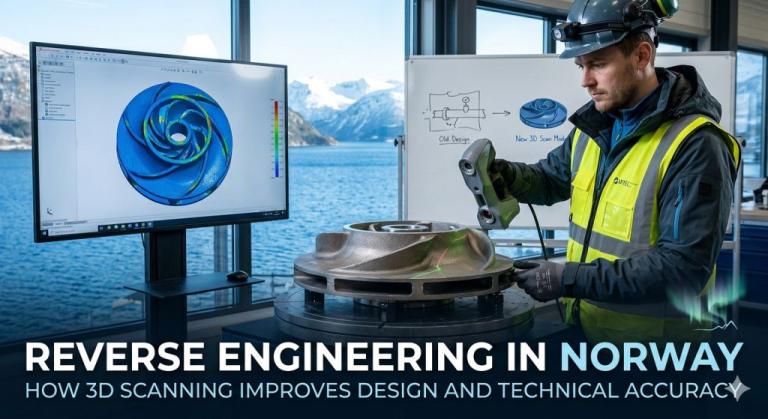
Reverse Engineering in Norway: How 3D Scanning Improves Design and Technical Accuracy

Reverse engineering in Norway is increasingly used by companies that need reliable data about an existing product, component, or technical system. Instead of starting with assumptions, engineers work from measurable geometry captured with 3d scanning and turned into usable CAD data.
- What reverse engineering means in practice
- From scan data to CAD models
- Why companies use reverse engineering in Norway
The result is a more effective development process based on precision and a clear understanding of how the object was made.
What reverse engineering means in practice
Reverse engineering is a method used to analyze a physical object and recreate its structure in digital form. In the engineering process, this usually begins with 3d scanning, which lets professionals capture details with high accuracy. That data then goes through data processing, so engineers can create models, review dimensions, and identify features that matter for quality and future design work.
This approach is useful when documentation is missing, outdated, or too limited for a new project. It can also help teams understand legacy equipment already available in the market.
From scan data to CAD models
The value of reverse engineering depends on how well the raw scan is processed. After capture, specialists clean the file, analyze the geometry, and convert it into CAD models that can support engineering and modeling tasks. In the right hands, this creates an accurate description of the product and gives clients data they can use.
A typical workflow includes:
- 3d scanning of the object with professional equipment,
- data processing and geometry analysis,
- creation of accurate CAD models for engineering and development.
Each stage needs precision, technical expertise, and a clear focus on the user needs of the project. That is why experienced engineers matter as much as the technology itself.
Why companies use reverse engineering in Norway
Reverse engineering in Norway supports innovation, especially in industries where quality and durability are critical. Companies use it to enhance existing solutions, make informed design updates, and shorten development time. It is also a practical way to analyze parts that are difficult to replace or no longer supported by the original manufacturer.
For clients, the benefit is not only technical. They receive data that can help with redesign, quality control, documentation, and product improvement. Whether the goal is to create a replacement part or understand the original design, reverse engineering provides a structured and effective path forward.